
The short answer
A development website has one job: help a buyer decide this could be home, then make it easy to ask about a specific plot or book a viewing. That takes more than a gallery of CGIs (computer-generated images) and a contact form. Buyers want the place, the plans, the prices and the process.
We built the website for a 43-home development in Winchester, so this comes from doing the work. Good websites for property developers are judged by what happens after the visit: who enquired, about which plot, and who replied.
The full list at a glance
Use the table as a quick pass, then read the sections below for what good looks like. The last row is the one most often missed, and it is where a CRM for property developers (a system that records every buyer and plot) earns its place.
| What to check | Why it matters |
|---|---|
| Location and lifestyle content | Buyers choose the area before the house |
| A clear site plan | Shows where each plot sits and what it faces |
| House types with floor plans and specification | Lets buyers compare homes properly |
| Live availability and prices or price guidance | Builds trust and avoids wasted enquiries |
| The buying process explained | Removes worry for first-time and chain buyers |
| Show home details and booking | Turns interest into a visit |
| Register of interest | Keeps buyers who are not ready yet |
| Enquiry route on every plot | Tells sales exactly what the buyer wants |
| Proof of the developer | Buyers are trusting you with a large purchase |
| Phone experience | A lot of early browsing happens on a phone |
| Search basics | Lets people find the development by name and town |
| Enquiry handling | An unanswered form is a lost buyer |
Show the place and the plan
Location and lifestyle
People buy a location first. Show the nearest schools, stations, shops and green space, and the journeys that matter locally, with real photography of the area in place of stock images. A map with the development pinned on it is worth more than a paragraph of adjectives.
Site plan
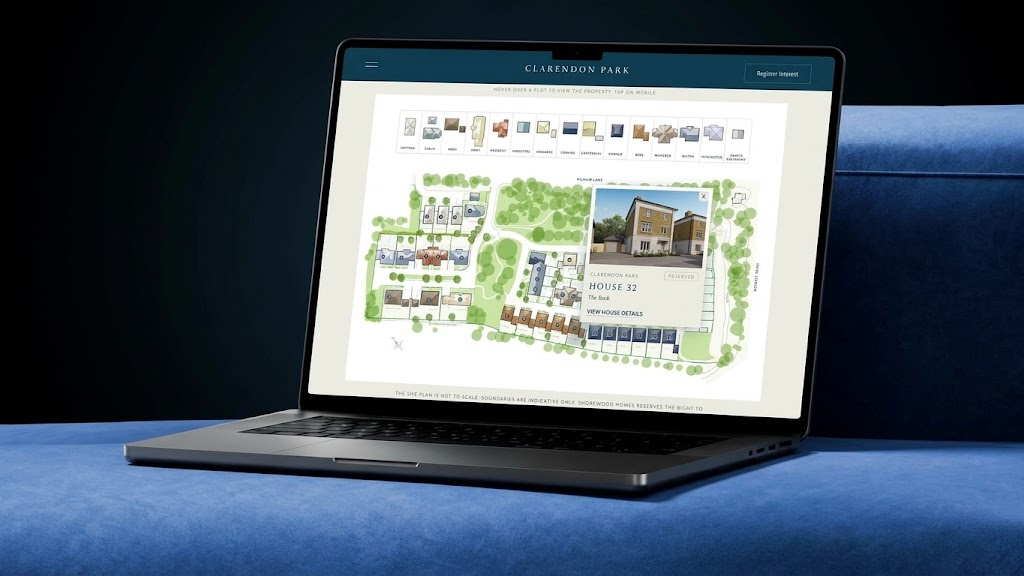
The site plan should show every plot with its number, house type and status. Buyers look for where the garden faces, how close the road is and where the parking sits. If the plan is interactive, selecting a plot should lead to that home's details. A clear static plan with a key is better than a clever one that fails on a phone.
Show the homes and what is available
House types, floor plans and specification
Give each house type its own page with floor plans, room dimensions, the specification (kitchen, flooring, heating, energy features) and images. Label CGIs as computer-generated and swap in photography when homes are finished. End each page with a way to ask about that home, which is the simplest way to generate more property buyer enquiries from visitors you already have.
Availability and prices
An availability list that is out of date damages trust quickly. Show each plot as available, reserved or sold, with a price or price guidance, and decide who updates it and how often. Keeping it current matters at every phase, as our guide on how to market a new property development explains.
Make the next step obvious
Every page should offer a next step that fits where the buyer is. Someone ready to view wants a booking. Someone a year away wants to stay informed.
- Show home: address, opening times, directions, parking and a way to book a slot online.
- Plot enquiry: a button on each plot or house type that carries the plot number into the form, so sales know what was asked.
- Brochure: a download in return for a name and an email address.
- Register of interest: a short form for people waiting on a later phase, asking bedrooms, budget range and timescale.
- Phone: a number that is answered, shown as a tap-to-call link on a mobile.
Keep forms short. Name, contact details, the plot or house type and one or two helpful questions are enough at this stage. Say what you will do with the details and only send marketing people have agreed to. Data protection rules apply, so check your own obligations.
Explain the buying process and prove who you are
Many buyers have never bought a new-build. Set out the steps in plain words: viewing, reservation, exchange, build updates, completion and what happens after moving in. Describe any warranty cover, schemes or incentives accurately, with their conditions.
Then show who is behind the development. Previous schemes with photographs, the team, the warranty provider and any code you are registered with, such as the New Homes Quality Code, all help. Buyers rely on what the site says, so it has to be accurate. Consumer protection law and advertising rules apply to marketing material, and you should check what they require of you.
Phone experience and search basics
- Open the site on your own phone using mobile data, and check floor plans can be read and enlarged.
- Check the site plan can be used with a thumb.
- Compress images and film so pages load quickly.
- Give the development and each house type a page title that includes the development name and the town.
- Set up a Google Business Profile for the show home or sales office with correct opening times.
- Make sure plot details exist as text on the page, not only inside a PDF brochure.
What happens to each enquiry
Test this before launch. Fill in every form yourself and see where the message lands, who is told and how long a reply takes. Each enquiry should reach a named person, be acknowledged with an automated confirmation, and be recorded with its source and plot. Portal and phone enquiries belong in the same record, so nobody has to check three places.
Common mistakes
- An availability list nobody owns, showing sold plots as available.
- Floor plans that only exist inside a brochure PDF.
- One general contact form for the whole development.
- CGIs with no label, or left in place long after homes are built.
- Show home times that do not match the sign at the gate.
- Forms that send to an inbox nobody checks at weekends.
Common questions
Should we publish prices on the website?
Buyers expect a price or at least guidance, and leaving it out tends to bring enquiries from people outside the budget. If prices are not set, give a guide and say when they will be confirmed. Keep whatever you publish accurate.
Do we need an interactive site plan?
It helps on a larger scheme, where buyers want to compare many plots. On a small development a clear, well-labelled plan with a status key does the job. Either way it must work on a phone.
What happens to the website once all the homes are sold?
It can become proof for your next scheme. Many developers keep a short version live as a completed development page, with photography of the finished streets, and point new visitors to current developments.
How long does a development website take to build?
It depends mostly on how ready the assets are. Plans, CGIs, specification and prices usually hold things up more than the build itself. A register of interest page can go live early while the full site is prepared.
What to do next
Go through the table with your own site open on a phone, and mark each row as present, weak or missing. Then send a test enquiry about one plot and time the reply.
If you would like a second pair of eyes, ask for our free 24-hour audit. A founder records a personal video walkthrough of your website within 24 hours, covering what a buyer sees and where enquiries could be lost. No call is needed, and a 15-minute call is optional.
Want this applied to your website?
George or Nicholas will record a personal walkthrough of your site within 24 hours.
Not ready for an audit? See Websites and systems for property developers.