
The short answer
Every survey costs a skilled person half a day once travel is counted. Sending that person to a tenant, a shaded roof or someone idly curious is the quickest way to make a busy installer unprofitable.
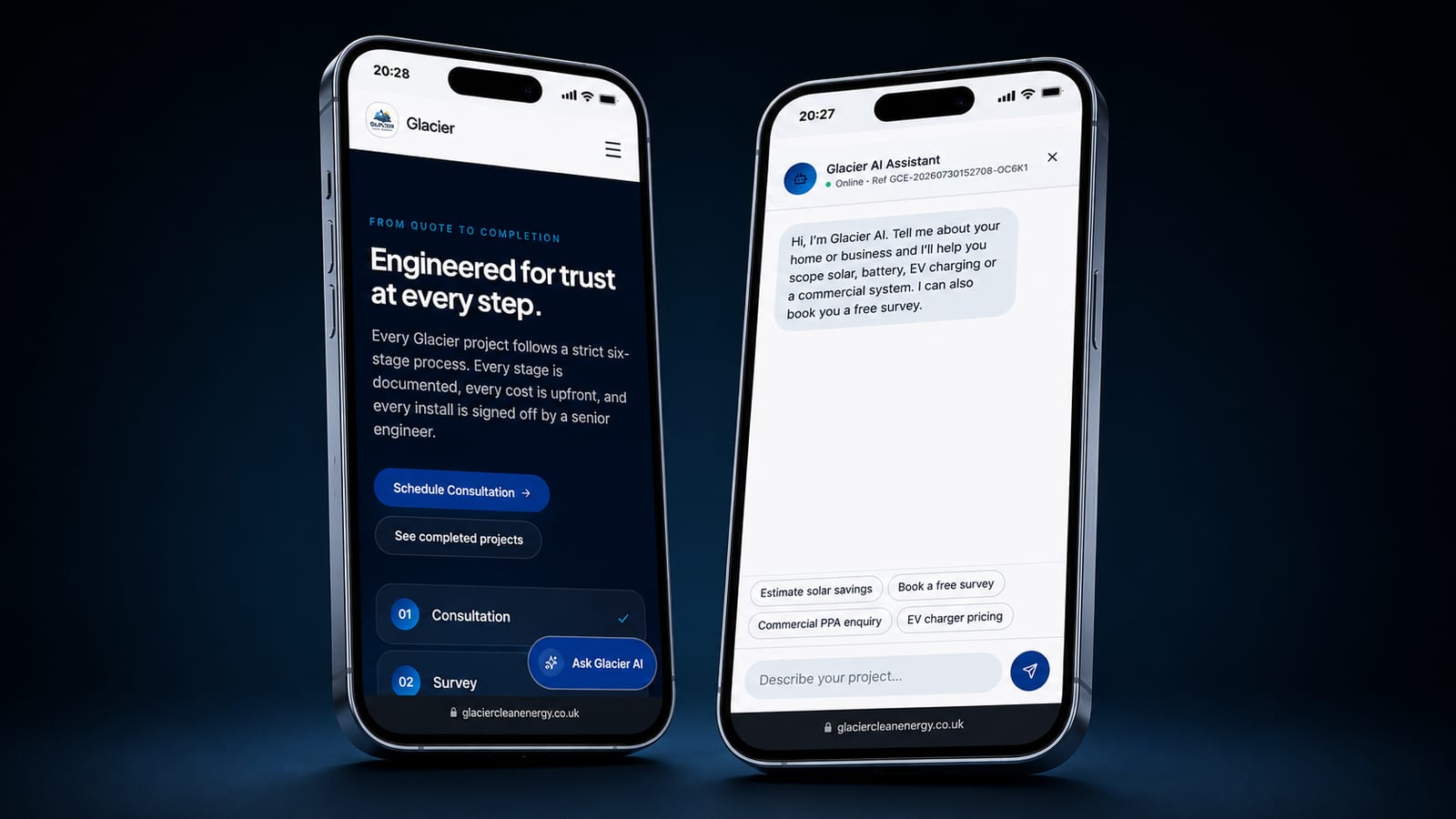
Qualifying is not about turning people away. It is about putting the right next step in front of each enquiry: a survey for those who are ready, a conversation for those who are nearly ready and useful information for everyone else. We built the website for a clean energy installer around a clearer route to booking a survey, so this guide follows what happens between the form and the visit.
The five things to establish
| Question | Why it matters | What changes the answer |
|---|---|---|
| Do they own the property? | Tenants usually need the owner's agreement | Landlords, leaseholds and shared roofs |
| Is the roof suitable? | Direction, pitch, shade and condition decide what is possible | Trees, chimneys, dormers and ageing tiles |
| How much electricity do they use? | The saving depends on use, and on when it is used | Home working, electric vehicles, heat pumps |
| Is there a budget or finance route? | Avoids a survey that ends at the price | Savings, finance, grants where available |
| When do they want to decide? | Separates buyers from researchers | A house move, a bill shock, a new car |
You rarely need certainty on all five. You need enough to know whether a visit is the right use of the day.
Ask without losing the enquiry
The temptation is to put every question on the website form. Long forms lose people, including good ones. Split the questions between the form, a quick desk check and a short call.
On the form
- Name, phone, email and postcode.
- Whether they own the property.
- A rough idea of the monthly electricity bill.
- What prompted the enquiry, as an optional line.
At your desk
With a postcode you can look at the roof on satellite and street-level images before you speak to anyone. Direction, obvious shading and roof shape are often clear enough to rule a property in or out, or to prepare the right questions.
On a short call
- Confirm who makes the decision, and whether everyone involved is on board.
- Ask what they hope the system will do: cut bills, charge a car, prepare for a heat pump.
- Ask about the roof's age and any planned work.
- Explain what the survey involves and roughly what systems cost, so there are no surprises.
- Ask when they would like it installed.
Ten minutes on the phone saves a wasted half day, and it starts the relationship with a person and not a form. Getting the right enquiries in the first place is covered in our guide to solar lead generation.
Ask for photographs
A few photographs sent before the visit can answer questions that would otherwise need a second trip. Ask politely, explain why, and make it easy to send them from a phone.
- The roof from the garden and from the street.
- The consumer unit, with the cover open.
- The electricity meter.
- The loft space, if panels or an inverter may go there.
- A recent electricity bill.
Customers who take the trouble are telling you something about how serious they are. Those who will not are telling you something too.
Score the answers simply
You do not need software to score leads. Three groups are enough, each with a different next step.
| Group | What it looks like | Next step |
|---|---|---|
| Ready | Owner, suitable roof, clear reason, wants it within months | Offer survey dates straight away |
| Nearly | Owner and suitable roof, but unsure on budget or timing | A call with indicative costs, then a survey if they wish |
| Not yet | Renting, unsuitable roof, or researching for the future | Honest advice, useful information and permission to stay in touch |
Write the rules down so everyone who answers the phone sorts enquiries the same way. Review them every few months against which leads actually became installations.
Let the system do the chasing
Much of this can run without anyone remembering it. A new enquiry gets an instant reply that sets expectations. A ready lead gets a link to book a survey. A request for photographs goes out automatically, with a reminder if nothing arrives. A not yet receives something useful a few months later.
Our guide to survey booking automation shows how those steps connect. The person-to-person call stays, because that is where trust is built.
Domestic and commercial are different
A homeowner decides alone or with a partner, often within weeks. A business has more people involved and a longer path.
- Check whether the business owns or leases the building, and what the lease allows.
- Ask who signs off spending and what they need to see.
- Ask for a year of electricity data, not one bill.
- Expect questions about connection to the local network, which larger systems need approved in advance.
- Allow for a longer timetable and more than one meeting.
Qualify commercial enquiries just as firmly. A site visit to a building the tenant cannot alter is a day lost.
Be honest when the answer is no
Some roofs will not pay back. Some households use too little electricity for a system to make sense. Saying so plainly costs you a sale you would not have enjoyed and earns a reputation worth having.
Keep a record of everyone you could not help and why. Circumstances change: people move, trees come down, prices shift. A short message a year later sometimes finds a different answer.
Put it on the website
Your website can do part of the qualifying before anyone enquires. A page that explains who solar suits, what affects the price and what the survey involves lets unsuitable enquiries rule themselves out and gives suitable ones the confidence to get in touch.
That is a core part of how we approach websites for solar installers, and our guide on how to market a solar installation company covers the wider plan.
What to say on the call
Open by thanking them and saying the call will take ten minutes. Explain that a few questions now mean the survey, if it goes ahead, is worth their time. Ask the questions in a natural order, starting with what prompted the enquiry. Finish by saying plainly what happens next and when.
If the answer is that solar is unlikely to suit them, say so kindly and explain why. People remember being told the truth.
Common mistakes
- Booking a survey for every enquiry without a conversation.
- A form so long that good prospects abandon it.
- Never discussing price until the survey is done.
- Assuming the person enquiring is the person deciding.
- Dropping not-yet leads instead of keeping in touch.
- No record of why enquiries did not go ahead.
Common questions
Will qualifying put people off?
Not if it is done well. A short call that helps the customer understand their options feels like service, not screening.
Should we charge for surveys?
Some installers do, refundable against the order. It filters casual interest and can reduce bookings. Test it and watch what happens to completed installations, not only to survey numbers.
How quickly should we respond to a new enquiry?
As fast as you can, ideally within the hour during working time. People enquiring about solar usually contact more than one installer.
Can a desk check replace a survey?
No. It tells you whether a survey is worth doing. The structure, the electrics and the exact shading still need to be seen.
What to do next
Look at your last twenty surveys and count how many became installations. For those that did not, note what you could have learned beforehand. That list is your qualifying script.
If the enquiry form itself is the weak point, ask for our free 24-hour audit. A founder records a personal video walkthrough of your website within 24 hours, following the path from first visit to booked survey. No call is needed.
Want this applied to your website?
George or Nicholas will record a personal walkthrough of your site within 24 hours.
Not ready for an audit? See Websites and systems for renewable energy companies.