
The short answer
Pick the market you want, then remove the reasons a careful buyer might hesitate. Solar is a large, technical purchase from a trade most people have never bought from before. The installer who explains it plainly, and proves they will be around to honour the warranty, tends to win.
We built the brand and website for a clean energy business, so this comes from doing the work. It rests on the same ground as our websites for renewable energy companies. Nothing here is legal advice, and no marketing can guarantee results.
Choose your market first
Trying to serve everyone makes the message vague. Each market buys differently, so decide where most of your effort goes.
| Market | Who decides | What they need from you |
|---|---|---|
| Domestic | A homeowner or couple | Trust, a clear process and a quote they understand |
| Commercial | Owner, finance lead, sometimes a landlord | A business case, references and little disruption |
| New build | Developers and main contractors | Reliability, paperwork and dates you keep |
| A specific region | Local buyers of any kind | Proof you work nearby and will come back for aftercare |
You can serve more than one, but give each its own pages and its own message. Be realistic about travel. A defined patch you serve well beats a national claim you cannot support. Where the enquiries for each market come from is covered in our guide to solar lead generation.
Trust is the main barrier
Buyers have heard stories about pushy sales and firms that vanish. Your marketing has to show, with evidence, that you are not that firm.
- Certification. Show the schemes and consumer codes you belong to, accurately. Never display a badge you do not currently hold.
- Warranties. Say what is covered, by whom and for how long. Separate the manufacturer's warranty from your own workmanship cover.
- Real installs. Photos of your own work, with the town, the property type and what was fitted.
- Named people. Who surveys, who installs and who answers the phone afterwards.
- Reviews on Google and other independent platforms, each one answered politely, including the difficult ones.
Explain a complex purchase simply
A buyer has to take in panels, inverters, batteries, export, scaffolding and paperwork in one go. Do the explaining for them. Lay out the steps from enquiry to survey, design, quote, installation and commissioning, and say what happens at each. Define every technical term the first time you use it.
Make the first step small and clear. For most installers that step is a survey, and survey booking automation lets a buyer pick a slot as soon as they enquire.
Keep claims substantiated
Savings and payback claims are regulated advertising territory. Make only claims you can substantiate, and show the assumptions behind any estimate. Check the rules of your certification and consumer code bodies, such as MCS and the consumer codes, for how performance and finances should be presented. Grants and schemes change, so point people to the official source instead of repeating terms that may be out of date.
The channels that do the work
Your website
Every other channel sends people to the site. It should say who you install for and where, explain each technology, show real work and make the survey easy to book. Our renewable energy website checklist goes through it point by point.
Local search and reviews
Many domestic buyers look for an installer nearby. Keep your Google Business Profile (the free listing shown in Google Search and Maps) complete and accurate, add photos of recent installs and ask every satisfied customer for a review. Only publish location pages for areas you really serve.
Content that answers buyer questions
Write down the questions your surveyors hear every week and answer each one on the site: whether a roof is suitable, what a battery adds, how long installation takes, what happens in a power cut, what maintenance is needed. Plain answers bring in people who are researching and shorten sales conversations.
Referrals
Happy customers are usually your cheapest source of work. Ask at commissioning, and again later once the system has proved itself. Builders, roofers and electricians can refer work too, so stay in touch with the ones you have worked alongside.
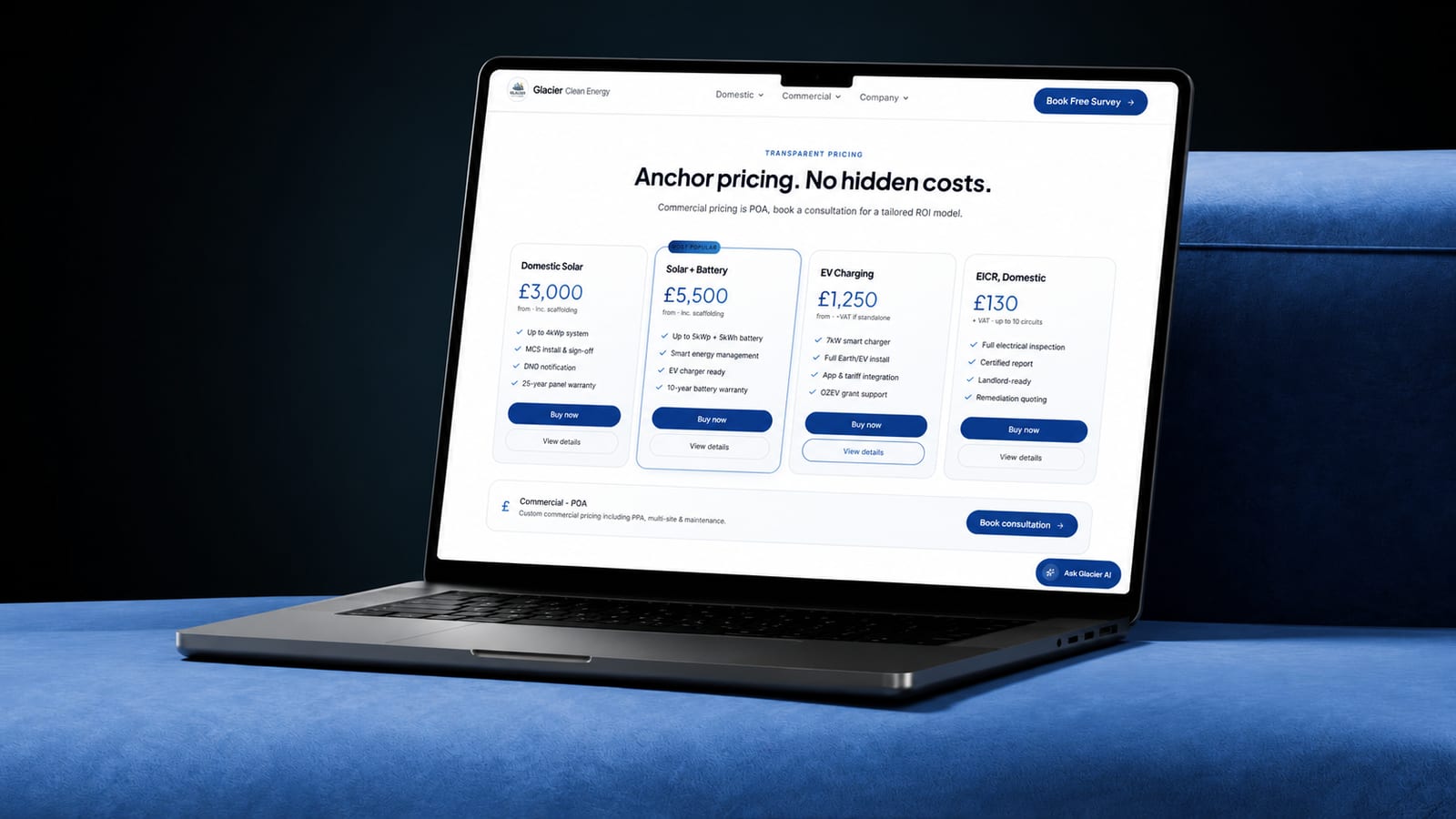
Commercial sales are a separate process
Selling to a business takes longer and involves more people. There may be a landlord, a finance director and a facilities manager, each with a different worry. The buyer wants a business case built on their own usage data, references from similar sites and a plan that keeps the premises running during the work.
- Give commercial buyers their own section of the site and their own enquiry form.
- Approach businesses with suitable roofs directly, with a specific reason for contacting them. Check the marketing rules that apply before you email or call.
- Expect several conversations before a decision, and plan your follow-up to match.
- Measure commercial work separately, so a slow sale does not hide a good source.
Follow up every quote
Quotes are often lost to silence, not to a competitor. The buyer got busy, had a question they did not ask, or was waiting for a partner to read it. Agree when you will call before you send the quote. Ring a few days later with a useful question, not a nudge. Check in once more after that, and stop if they say no.
Seasonality and policy changes
Interest tends to rise and fall with the seasons, energy prices and the news. A policy change can move demand sharply in either direction. You cannot control any of that, so do not build your marketing on one scheme or one busy period.
Keep wording about grants and tariffs general and current. Use quieter months to gather reviews, photograph installs and write content. Keep a list of people who asked to be contacted later, and contact them.
Common mistakes
- Leading with savings figures you cannot substantiate for the customer in front of you.
- Using stock photos instead of your own installs.
- Claiming national coverage when you serve a few counties well.
- Treating homeowners and businesses as the same buyer.
- Sending a quote and never calling.
- Leaving old grant or scheme details on the site after the rules change.
Common questions
Which channel should we start with?
Start with what you already have: past customers, reviews and your listing on Google. Then fix the website so anyone who looks you up finds proof and a clear next step. Paid adverts tend to work better once those are in place.
Should we advertise on price?
Rarely as the main message. Every system is designed for a property, so a headline price invites the wrong comparison. Explain what affects cost and let the survey produce a real figure.
Can we mention grants and schemes?
Yes, in general terms, with a pointer to the official source. Terms change, and out-of-date details mislead buyers and damage trust. Check your own obligations under your certification and consumer code.
How do we know what is working?
Record the source of every enquiry and follow it through to survey and install. Judge each channel on cost per install, not on clicks or enquiries alone.
What to do next
Decide which market gets most of your effort this year, then read your own website as a cautious buyer would. Check whether it proves who you are, explains the process and makes the survey easy to book.
If you would like an outside view, ask for our free 24-hour audit. A founder records a personal video walkthrough of your website within 24 hours, with specific points to fix. No call is needed, and a 15-minute call is optional.
Want this applied to your website?
George or Nicholas will record a personal walkthrough of your site within 24 hours.
Not ready for an audit? See Websites and systems for renewable energy companies.