
The short answer
You get the enquiries you appear to want. If your website, Google listing and van all say 'no job too small', small jobs are what arrive. To attract larger projects, show larger projects, say what you take on and make it easy for the right client to get in touch.
This is about quality, not volume. A few well-matched enquiries are worth more than a full inbox of work you will decline. Nothing here guarantees a result, but each step makes the right enquiry more likely.
Why the small jobs keep coming
| Symptom | Likely cause | What to do |
|---|---|---|
| Mostly repairs and odd jobs | Site and listing say 'all building work undertaken' | State the type and size of project you take on |
| Enquiries from well outside your area | No areas named, or too many | Name the main towns you cover |
| Clients with no idea of budget | No guidance on cost anywhere | Explain what drives cost and how you price |
| Good enquiries go quiet | Slow first reply | Acknowledge at once, call the same day |
| Many quotes, few wins | Quoting for anyone who asks | Qualify before you price |
Your Google Business Profile, the free listing shown in Google Search and Maps, matters here too. Its categories, services and photos tell people what you do before they reach the website. Our guide to SEO for builders covers how to set it up for the work you want.
If good enquiries arrive but the work is not won, the gap is usually after the quote goes out. We cover that separately in how to follow up building quotes.
Show the projects you want more of
Clients look for evidence that you have done a job like theirs. Put your best large projects first, each with the brief, the scope and good photographs. Move minor works out of the gallery. Effective websites for builders lead with the project types the firm wants next, not a record of everything it has done.
Say plainly who you work for and at what scale. A sentence such as 'we take on extensions, full refurbishments and new builds, and do not usually quote for small repairs' is polite and saves everyone time. The wider plan is in our guide on how to market a building company.
Apply the same edit to your Google listing and social profiles. Replace photos of small repairs with finished larger projects, and rewrite the description so it names the work you want.
Ask qualifying questions
Qualifying means finding out early whether an enquiry fits. A few questions on the form or the first call do most of it.
- Project type: extension, refurbishment, new build, fit-out or something else.
- Location: a postcode is enough.
- Budget range: offer bands and a 'not sure yet' option.
- Timing: when they hope to start.
- Planning status: whether drawings exist and whether any permission needed has been applied for or granted.
- Who else is involved: an architect, surveyor or designer.
Keep the form short and explain why you ask. People answer a budget question more readily when it is a range and when they can see it helps you reply properly. Do not give planning advice in your reply. Point clients to their architect or the local authority, and check your own obligations on anything regulatory.
Respond fast while you are on site
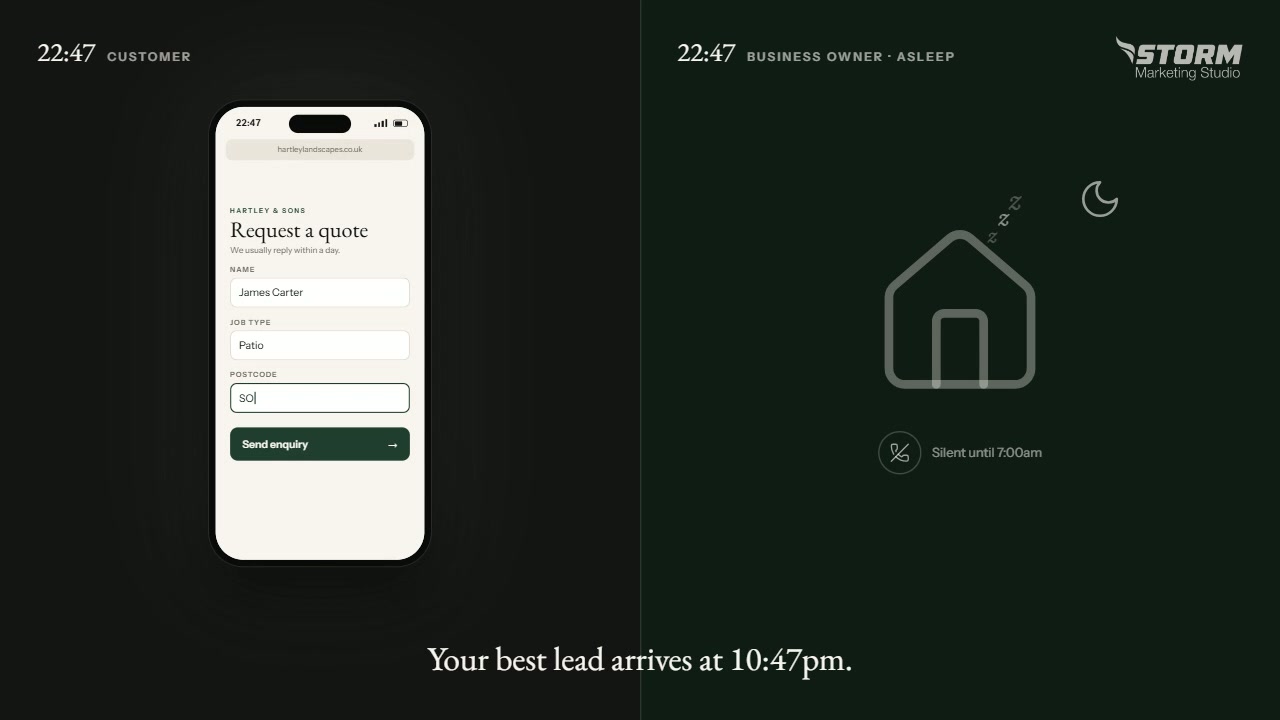
A client who sends a considered enquiry about a large project has often contacted more than one firm. The one that replies first, and sensibly, starts ahead. That is hard when you are up a scaffold.
- Send an instant acknowledgement that says when you will call.
- Have each enquiry alert a named person by text or WhatsApp, not only an inbox.
- Agree who returns calls each day, and by when.
- Use an automated workflow to log every enquiry with its answers, so none is lost.
- Call the same day where you can. A short call beats a long email.
The first reply does not need to answer everything. It needs to show that a real person has read the enquiry, mention the project by type and place, and propose a time to talk.
Referral sources worth cultivating
Larger projects often come through people, not searches. The most useful are those who meet the client before a builder is chosen.
- Architects and architectural designers.
- Building surveyors and structural engineers.
- Interior and kitchen designers.
- Estate agents and commercial property agents.
- Past clients and their neighbours.
Keep in touch, send photographs of finished work and tell them the kind of project you want. Thank anyone who refers you, and let them know how it went.
Turn away poor fits politely
Declining well protects your reputation. Reply promptly, thank them, say the job is outside what you take on and, where you can, suggest a firm or trade better suited. The person you turn down today may have a larger project later, or a neighbour who does.
A reply can be as short as this: thank you for getting in touch, this is smaller than the projects we take on, and a local general builder or handyman is likely to serve you better.
Measure value, not count
Record every enquiry with its source, project type, rough value and outcome. Then look at the total value of suitable enquiries each month, not the number. A spreadsheet is enough. Over time it shows which sources bring the work you want and where to put your effort.
Review it every few months. If one architect, or one page of the site, keeps producing the right projects, give it more attention. If a source only brings work you decline, change what it says or drop it.
Common mistakes
- Saying 'no job too small' while hoping for large projects.
- Leading the gallery with minor works.
- A form that asks only for a name and a message.
- Replying to enquiries days later.
- Quoting for every job in case it leads somewhere.
- Counting enquiries and ignoring what they were worth.
Common questions
Will asking about budget put people off?
Some, and usually the ones who were not a fit. Offering ranges and a 'not sure yet' option keeps it comfortable. Explain that it helps you give a useful answer.
Should we stop taking small jobs altogether?
That is a business decision. Many firms keep small works for past clients and referrers while no longer advertising them. The aim is to stop your marketing attracting them.
Do adverts bring larger projects?
They can, if the advert and the page it leads to are specific about project type and scale. Broad adverts tend to bring a broad mix. Results vary.
How quickly should we reply?
As soon as you reasonably can, and the same day where possible. An immediate acknowledgement followed by a call from a named person works well.
What to do next
Go through your recent enquiries and mark the ones you wanted. Then look at your home page, gallery and Google listing and ask whether they explain the mix.
If you would like an outside view, ask for our free 24-hour audit. A founder records a personal video walkthrough of your website within 24 hours, showing what it tells a prospective client about the work you want. No call is needed, and a 15-minute call is optional.
Want this applied to your website?
George or Nicholas will record a personal walkthrough of your site within 24 hours.
Not ready for an audit? See Websites and systems for builders.