
The short answer
A new kitchen, bathroom, loft conversion or whole-house renovation is a considered purchase. The customer spends a lot, lives with the result for years and lets you into their home for weeks. They take a long time to decide, and they choose the firm they trust most, not the first one they find.
So the marketing job is to build that trust before you meet: real projects shown in depth, a process that is explained, plain guidance on budgets and patient follow-up. No approach guarantees work, but each of these gives a careful buyer a reason to pick you.
How renovation customers decide
Renovation buyers research for weeks or months. They collect ideas, ask friends, look at several firms' work and only then ask for quotes. Each stage needs something different from you.
| Stage | What they are doing | What helps |
|---|---|---|
| Ideas | Saving photos, working out what they want | Project pages, social posts of real work |
| Shortlist | Comparing local firms | Reviews, local search, detailed projects |
| First contact | Booking a showroom or home visit | An easy booking route and a fast reply |
| Quote | Weighing price, design and trust | A clear written quote and a named contact |
| Decision | Talking it over, often for weeks | Polite follow-up and answers to late questions |
Good websites for trades are built for this slower journey. A renovation site has to do the work of a showroom: let people look closely, understand how you work and take a small first step.
Two stages lose the most work. The first is first contact, when a call to the office rings out because everyone is on site. Our guide to missed-call automation for trades shows how to catch those callers.
The second is the decision stage, where many firms send a quote and go quiet. If remembering to chase is the problem, see how to automate quote follow-ups.
Reviews, referrals and local search
Much renovation work still starts with a recommendation. The difference now is that the person you were recommended to looks you up before calling. What they find has to match what their friend said.
- Ask every customer for a review at handover, and ask them to mention the type of project and the town.
- Aim for a steady flow of reviews on Google, not a burst.
- Make referring easy: tell past customers you welcome introductions, and thank them when one arrives.
- Check in once the room has been lived in for a while.
- Keep your Google Business Profile accurate, and add photos of finished projects often.
People also search for the job and the town, such as 'kitchen fitters' or 'loft conversion' with a place name. Give each type of project its own page, and add pages for the main areas you really cover. Our guide to local SEO for trades explains the full set-up.
Show finished projects in depth
A grid of nice photos is a start. A full project page is far more persuasive. For each job you are proud of, tell the story.
- The brief: what the customer wanted and what was wrong with the old room.
- The constraints: an awkward layout, a low ceiling, a family living in the house throughout.
- What you designed, and why.
- Photos before, during and after, taken in good light.
- How long it took and the rough budget band, if the customer agrees.
- The town, and a few words from the customer.
Always ask permission before showing someone's home. Pick projects like the ones you want more of, because people ask for what they see.
Explain your process and give budget guidance
The design and quote process
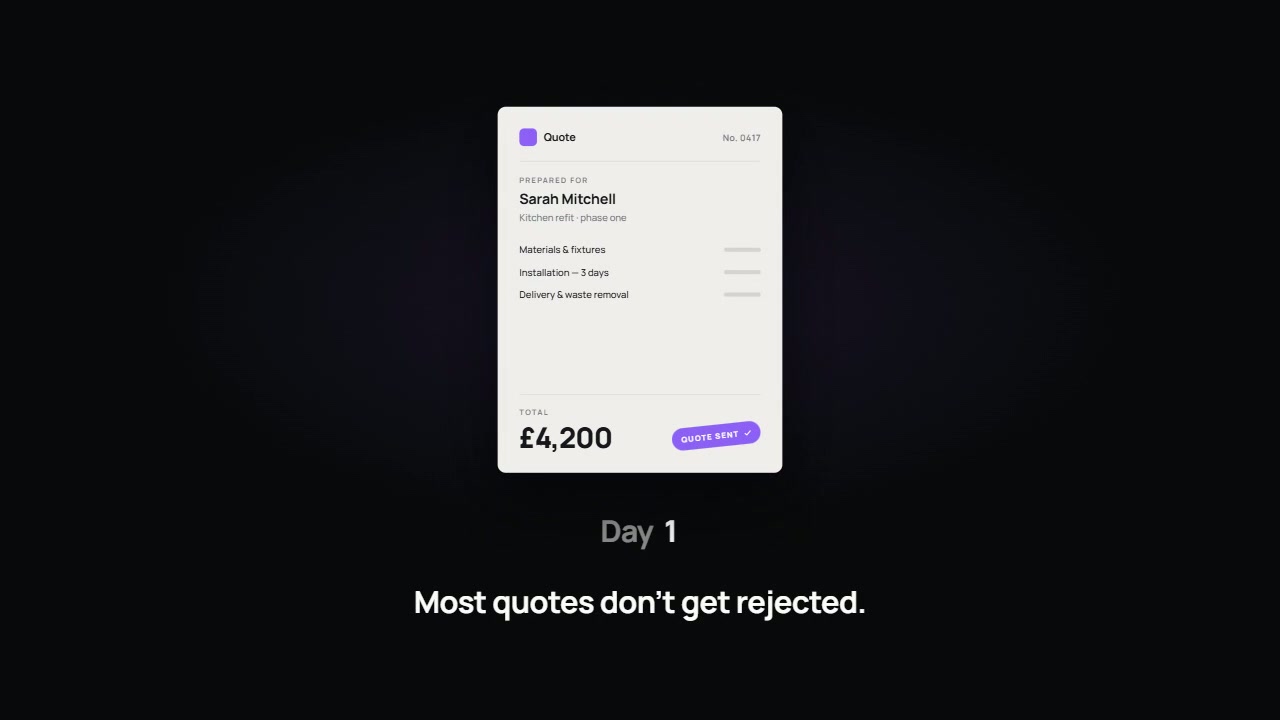
Most people have never bought a renovation before and do not know what happens after they get in touch. Set it out in steps: first conversation, visit and measure, design, written quote, revisions, deposit, start date, who manages the job and what happens at handover. Say who they will deal with at each step.
Budgets
You cannot price a loft conversion on a web page, but you can give guidance: what a typical project includes, what pushes the cost up and the range you usually work within. This saves both sides a wasted visit and shows serious buyers you are open about money.
The first step
Offer one clear first step: a showroom appointment if you have one, a home visit if you do not. Say how long it takes, what to bring and that there is no obligation. Reply to every request quickly.
Use social media to show real work
Renovation is visual, and buyers spend the ideas stage scrolling. Social media earns its place when it shows your own jobs: progress shots from live sites, short walk-throughs of finished rooms filmed on a phone in daylight, the people on your team by name and answers to the questions you hear every week. A couple of real posts a week, kept up all year, tends to do more than a burst before a quiet month.
Follow up quotes over weeks
A renovation quote is rarely accepted the day it arrives. People talk it over, wait for other quotes, check their finances and sometimes go quiet for a month. Silence usually means 'not yet'. The firm that stays in polite contact is often the one still in mind when they decide.
- A message a few days after the quote, asking if anything needs explaining.
- A check-in a week or two later, offering to adjust the design or the specification.
- A final note some weeks on, saying the quote is still open and until when.
- A clear stop. If they say no, thank them and leave it.
Where a contract is agreed in the customer's home or at a distance, consumer cancellation rights may apply. Building regulations and planning rules may apply to the work itself. Check your own obligations.
Choose the jobs you want
Marketing attracts more of whatever you show. If you want whole-house projects, lead with them. If small bathroom refits no longer suit your team, stop featuring them and say what your typical project is. A clear minimum, stated politely, saves visits to jobs you would turn down.
Common mistakes
- Photo galleries with no story, town or detail.
- No guidance on budgets, so every enquiry is a guess.
- Sending a quote and never mentioning it again.
- Showing every kind of job, including ones you no longer want.
- Social posts made of stock images or supplier brochures.
- Slow replies to showroom or visit requests.
Common questions
Should we put prices on the website?
Give ranges and what drives them, not a fixed price list. Buyers want to know if you are in their bracket before they book a visit. Being open about money tends to bring better-matched enquiries.
Do we need a showroom?
No. A showroom lets people touch and compare, but a well-run home visit with samples and past project pages can do the same job. What matters is that the first step is clear and easy to book.
How often should we follow up a quote?
Enough to stay in mind, not so much that it feels like pressure. A few contacts spread over several weeks, each with something useful to say, is a reasonable pattern. Stop when they ask you to.
Which social platform should we use?
The one your customers already use to collect ideas, which for home projects is usually a visual one. Doing one well beats doing four badly. Judge it by enquiries and bookings, not followers.
What to do next
Start with your three best projects and turn each into a full project page. Write out your process in steps. Then look at what happens to a quote after you send it.
If you would like us to look, ask for our free 24-hour audit. A founder records a personal video walkthrough of your website within 24 hours, with what we would change first. No call is needed.
Want this applied to your website?
George or Nicholas will record a personal walkthrough of your site within 24 hours.
Not ready for an audit? See Websites and systems for trades and home improvement.